Thursday, March 15, 2012

GRACED FRIENDSHIPS PART II OF IV: Same Sex Attraction

SAME-SEX ATTRACTION


The way this topic must be addressed is in the context of REDEMPTION.

Every single human person has a grave disorder.  It's called sin.  Each of us can say "There is a war in my members."  The best way we can describe it is with St Paul's words:
I do not understand my own actions. For I do not do what I want, but I do the very thing I hate.  Now if I do what I do not want, I agree that the law is good.  So then it is no longer I that do it, but sin which dwells within me.  For I know that nothing good dwells within me, that is, in my flesh. I can will what is right, but I cannot do it.  For I do not do the good I want, but the evil I do not want is what I do.  Now if I do what I do not want, it is no longer I that do it, but sin which dwells within me.  So I find it to be a law that when I want to do right, evil lies close at hand.  For I delight in the law of God, in my inmost self,  but I see in my members another law at war with the law of my mind and making me captive to the law of sin which dwells in my members.  Wretched man that I am! Who will deliver me from this body of death?  Thanks be to God through Jesus Christ our Lord! So then, I of myself serve the law of God with my mind, but with my flesh I serve the law of sin.  (Romans 7:15-25)

This is not only the interior experience of every sinner, but also  of those who suffers same-sex attraction.  Some people would like to affirm people in a gay identity, but this cannot be the Christian response, because the act itself, not the person, is intrinsically disordered, and if we love someone, we would not want them to be in habitual grave sin.  What then?  Do we try to fix them or change them?  With this idea I would be careful of attempting to try to fix a person.  They are a person who needs to be loved not necessarily a problem to be solved and sometimes God might permit them to suffer this in some way for the rest of their life.  What they do need is the same as everyone else - Redemption!  Let's look at the causes of same-sex attraction to try to seek a path of redemption.


UNLOVED, UNAFFIRMED, 
AND IN NEED OF REDEMPTION

A person finds themselves sexually attracted to the same sex usually because of an unmet need for affirmation, love, and affection they had as a child from the same-sex parent or also as a result to the abuse or hurt received from the opposite sex parent, or differing variables of abuse and neglect from either parent.  In fact, many psychologists and counselors have had great success with those who have unwanted same-sex attractions in helping to heal this as one would do with a disordered affection in the passive will of the person.  This will undoubtedly upset many people who do not have a catholic vision of man and his anthropology found in the theology of the body, who attempt a kind of gay-affirmation therapy, focussing on depression or stress as results of social resistance to the gay lifestyle rather than something much deeper in the human heart.  These people say that would be unfair to ask a person to change something so deep in his heart.  Remember, that 80% of our sexual identity is formed before the age of 5 and therefore one could claim that he was always that way.
We must be clear that this kind of healing or change is not to be considered as a 
categorical view of change, grounded in an essentialist view of homosexual sexual orientation that assumes same-sex attractions are the natural and immutable essence of a person,” but “it is far more helpful and accurate to conceptualize such change as occurring on a continuum.  This is in fact how sexual orientation is defined in most modern research, starting with the well known Kinsey scales, even as subsequent findings pertinent to change are often described in categorical terms.” (NARTH Statement on Sexual Orientation Change) emphasis added
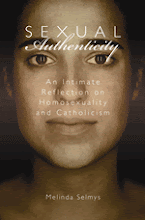
Order today!
Order Sexual Authenticity
Visit her Blog
 One of the most honest and realistic looks at same-sex attraction comes from Melinda Selyms, who wrote, “Sexual Authenticity: An Intimate Reflection on Homosexuality and Catholicism.”
“It's my suspicion that in a lot of cases, people who struggle for years with same-sex attraction are struggling because there are other factors driving their attractions, and these factors are not being addressed. For some people, it seems, the issues are rooted in psychological wounds received in their family of origin, and for those people reparative therapy seems to do a lot of good. Resolve the psychological substrata of sexual orientation, and the attractions sort themselves out of their own accord.” 
Especially for men, who are often more sensual, same-sex attraction is more of a matter of a libinistic sexual attraction, for women, who are often more sentimental, it  tends toward an attraction of the whole of the person to the whole of the other person.  For both of these it is still a need for love and affirmation.  Again here it is necessary to stress that one does not change their passive will overnight or categorically or by an act of the active will.  It happens when the person gifts their inmost being freely and consciously to the desire for Redemption.  This voluntary desire is key.  You know the joke, how many psychologists does it take to change a lightbulb?  It doesn’t matter.  The light bulb has to want to change.  For those who don’t want this, it is not an option and often by these people it is seen as an attack on their lifestyle.  From my experience in living in Christian mens’ households where a few of the men professed to experience an unwanted same-sex attraction, the two things they needed from me were:
1.  Brotherhood.  Healthy male “disinterested friendship” (Words of the Catechism)  supplied positive and chaste affirmation of them as men in a masculine identity.
2.  A condemnation of the “homosexual acts as acts of grave depravity” (Words of the Catechism)
I suspect this is because that it is an affirmation of them as a man but also a support to their choice of trying to live a chaste life through a reinforcement of the negative choice involved, like the positive and negative poles necessary for electric power.  The deeper changes in us are much more slow and permanent, yet also some may experience that they will have to suffer some degree of temptation the rest of their lives.  The courage apostolate has the appropriate quote of St Frances de Sales on their website:
"Have patience with all things, but chiefly have patience with yourself. Do not lose courage in considering your own imperfections but instantly set about remedying them - every day begin the task anew."
This apostolate has been most effective at least with helping many men and women come to terms with same sex attraction.  Their 5 goals are:
1.  Live chaste lives in accordance with the Roman Catholic Church's teaching on homosexuality. (Chastity)
2.  Dedicate ones life to Christ through service to others, spiritual reading, prayer, meditation, individual spiritual direction, frequent attendance at Mass, and the frequent reception of the sacraments of Reconciliation and Holy Eucharist. (Prayer and Dedication)
3.  Foster a spirit of fellowship in which all may share thoughts and experiences, and so ensure that no one will have to face the problems of homosexuality alone. (Fellowship)
4.  Be mindful of the truth that chaste friendships are not only possible but necessary in a chaste Christian life and in doing so provide encouragement to one another in forming and sustaining them. (Support)
5.  Live lives that may serve as good examples to others. (Good Example/Role Model)
Yet some people have no intention of wanting or believing that a change in their sexual orientation is possible.  The media often reinforces this with a subtle kind of brainwashing by a constant propaganda line that “I was born this way” It is clear now that, even as Dean Hammer, who who supposedly coined the phrase of the “gay gene”  himself has said, “there is no gay gene” and therefore is not an variant of human nature or a genetic thing.  THERE IS NO STUDY THAT CLAIMS HOMOSEXUALITY IS SIMPLY GENETIC.  It is shown from studies of twins that it is not inherited, even though studies may show that it may be heritable or traced to certain biological traits.  It also therefore cannot be considered on par with other aspects of human nature such as age, race, gender, and ought not to be described as a “right” or encoded into discrimination laws as a variant.
Also it must be said very clearly that it is not a good thing even though it may be socially acceptable and legal, for two men or two women to claim to have the same “right” or capacity to raise a child in a healthy environment.  Dr Dean Byrd, a psychologist and counselor, who was a consultant for an adoption agency on this matter reveals that in many cases it may greatly harm the emotional and personal well being of the child:
“How healthy is the rejection of gender roles? What is more alarming is that both historical and current research provides significant concerns about the medical and mental health consequences of homosexual practices, as well as the stability of homosexual relationships. Medical health, mental health, longevity and relationship stability are essential issues to be addressed when considering the placement of children.” Gender Complementarity and Child-rearing: Where Tradition and Science Agree
Through analysing different studies he concludes that child rearing in a same sex home will:
-teach by example the rejection of our sexual differences that are inscribed in our nature
-teach children that sex is for pleasure and doesn’t have to include procreation
-due to the very high rate, even majority of couples that are not monogamous, even saying it is better to let their partner freely have sex with others to remain monogamous, the child will not learn stability that comes from monogamy
-the child will have a high rate of confusion of gender identity, a much higher tendency toward depression, emotional imbalance, and promiscuity

NO ONE IS A VICTIM OF CIRCUMSTANCE 
OR DOOMED BY HISTORY
Because of the identification that we have with the way we grew up and because so much of who we are depends on the formation we receive as tiny children, it is easy for a person to feel condemned to simply be the outcome of their past, marked forever by a distant mother or absent father or whatever kind of childhood.  You hear it all the time in popular culture, songs, and movies - almost like an excuse for self-pity or a definition of who a person is based solely on what has happened to them.  Yet what is most wounding in our lives is not what has or hasn’t happened to us, it is our own reaction to it.  However, we know that God is a Good Father, and his plan is for freedom and healing.
What is the healing of someone who has been wounded by their fundamental relationships in life: graced friendships.
Read next installment where we talk about healing

Theology of the Body Lenten Series Part II of IV: Healing Our Relationships Through Graced Friendships


View the transcript of the talk or download it and print:
Healing of Our Relationships Through Graced Friendships

Wednesday, March 14, 2012

GRACED FRIENDSHIPS PART I of IV: Masculine and Feminine Love and Affirmation or Lack Thereof

This is a talk I delivered at St Patrick's in Soho on Wednesday, March 14, 2012


I believe this song is helpful to understand the effect that our Father's voice has within us.


I ran away from your love but you waited for me, yes, you waited for me 
and then I heard your song, singing over me, singing over me
Now that I hear you Lord, I want to know you more.  I want to know you more.
Chorus : Sing your song to me. Oh, there’s no greater thing  
than to listen to the sound of your voice
When I hear your song I want to sing along 
and listen to the sound of your voice, 
the sound of your voice
Lord, I am calling your name and I’m waiting for you, yes I’m waiting for you
So won’t you show me your way and I will follow you, yes I will follow you  Chorus
Singing over me bringing peace and mercy with a song that never ends
Sining over me marvelous and holy, Lord, I want to hear your song again   Chorus
THE SOUND OF MY FATHER’S VOICE
I remember as a child about the age of four years old waking up in the middle of the night with a terrible ear ache.  It seemed also that my whole body was on fire, as if I was immersed in pain.  Suddenly I heard the sound of my father’s voice.  I think he might have heard me crying in my sleep and came over to see what was the matter.  He picked me up and held me.  He gave me some medicine for my ear ache and what probably was a bad cold, but the pain was so great that I couldn’t find peace.  So he put me on the couch and read me a picture book story.  This was the first memory I had of the power of the voice of my father.  I didn’t really care what he said or what the story was about.  I just liked listening to the sound of his voice.  It was saying to a deeper part of me, that he loved me, that I was lovable, that I was good.
Many times in my childhood his voice spoke to me this message.  I remember driving to work with him.  He was a carpenter and it was an hour drive to the construction site from our home.  He used to sing to me, talk to me, and tell me stories.  I don’t remember a lot of what he said, but I always remember how I felt when I heard the sound of his voice.  I guess the first time I realized the need I had to hear this voice was when I was in college.  I was struggling with figuring out how to balance the difficult schedule of studying, my after school job, and trying to grow up.  When I called him on the phone I distinctly remember the great confidence I felt just listening to my father’s voice.  It always seemed to give me a deep peace, a kind of strength in my bones, in my heart of hearts I found that because my father gave me the gift of his time, his words, and above all, his love, that I am a lovable person and that I am capable of doing whatever this life demands, even if at times these are very difficult things.
MY MOTHER’S VOICE
My father’s voice was not the only voice that spoke to my soul.  The most constant contact I first had with anyone was my mother.  She said I used to spend the whole day by her side as a toddler, and that I used to hide in her skirt when I felt danger was near, that she was my refuge and comfort.  I remember her as my first best friend and playmate.  When I heard the sound her voice it made me feel very calm and many times, because she would speak with all sorts of funny accents, I would laugh and giggle.
I first noticed the imprint of my mother’s voice when I found myself in great danger.  I was in a Philippine jungle where it was said that armed soldiers were hiding  that wanted to overthrow the government.  They had kidnapped many western missionaries and held them for ransom.  When faced with the choice to go a short way across a mountain path that was supposedly covered with these armed forces, or to go the long way that was safer, I distinctly heard the voice of my mother, “Be careful!  Don’t do anything foolish.”  What?  How did my mother’s protective voice find it’s way into my conscience?
WE LONG TO HEAR THE VOICE OF OUR FATHER AND MOTHER
Why is it that we are so deeply comforted to hear the voice of our father and mother, why does their voice become such a profound part of our hearts and consciences?  Why do we long for their love?  The truth about the human person is that each is created by and for a loving communion of persons.  In the beginning we read:
So God created man in his own image, in the image of God he created him; male and female he created them. (Genesis 1:27)
This means that, as Blessed Pope John Paul II says in his theology of the Body,
“man became the image of God not only through his own humanity, but also through the communion of persons”
For just as the Eternal Father is one with the Eternal Son and from their intimate communion of persons is conceived and flows the Person of the Holy Spirit, so too, from the intimate communion of man and woman is conceived and flows a new human person.  This new life happens in the conception of the womb but also it ought to happen every day in family life.  The very same love of the Eternal Family of the Blessed Trinity is replicated and echoed in the love of man and woman who not only in the act of conception but by their communion and friendship daily give life to their children.
It is amazing to see the connection between trinitarian theology and the differences between man and woman.  God the Father is the origin (what the name actually means in Greek) of the Son and Holy Spirit.  He is the principle or initiation of the other two persons.  God the Son is eternally receptive to the Father and his love.  From the love of both Father and Son comes the Holy Spirit.  In this understanding of the Blessed Trinity, we can understand the pattern of masculine and feminine complementarity and fertility.  Dr Philip Mango, a psychologist who teaches a kind of “psychology of the body” that accompanies the theology of the body says:
“The definition of masculinity is the male who takes initiative regularly.  He initiates something that is good for others at a cost to himself, at a sacrifice to himself, and sustains what he has initiated with power and love, as a positive leader, as a protector, defender, lover, and a wise counselor.“The definition of femininity is active receptivity.”
Masculinity and femininity are from God, have their origin in his image and likeness and a person who has underdeveloped their manhood or womanhood is not living the fullness of their dignity as a son or daughter of God.  We can see that masculinity and femininity have been lived out in different ways throughout the ages and in different cultures, but their origin is in God and is not simply sociological evolution or mere cultural conditioning.  These are ultimately made for life.  What does man initiate in the seed of his body and woman receive within her body?  LIFE!
It is written into our nature, which by scientific studies, can be observed and noted.  According to the social sciences:
There is no fact that has been established by social science literature more convincingly than the following: all variables considered, children are best served when reared in a home with a married mother and father. David Popenoe (1996) summarized the research nicely: "social science research is almost never conclusive, yet in three decades of work as a social scientist, I know of few other bodies of data in which the weight of evidence is so decisively on one side of the issue: on the whole, for children, two-parent families" (p. 176).  (Gender Complementarity and Child Rearing by Dr A. Dean Beard PhD)
THE EFFECT OF MASCULINE AND FEMININE VOICES
There was a study done in a pediatric ward with small infants.  They had a room full of babies whose neurological activity was being monitored.  When a man walked into the room and started speaking to the babies, they started to kick and wiggle and move about.  Their brain activity became very active, their eyes widened, and they looked around the room full of excitement.  When a woman walked into the room and started talking to the babies, they lay still, their neurological activity became calmer, their eyes started to close, and some started to fall asleep.
Another study shows that father’s around the world in different cultures and socio-economic backgrounds have a kind of universal tendency to hold their baby out from them, to look them in the eye, and yes, even to throw them up in the air and catch them.  The study was not limited to cultural conditioning.  Yes that is right, it is a universal tendency in father’s to actually throw their children up in the air.  For women it is exactly the opposite.  They desired to hold the child close to their hearts, pull them in, and give them nurturing and gentle caresses.  If you’d ask the woman they would tell the man to not throw the child so high and his reaction would be that it wouldn’t quite be high enough.  Different studies show the complementarity of masculine and feminine touch in rearing children:
“Male and female differences emerge in ways in which infants are held and the differential ways in which mothers and fathers use touch with their children. Mothers more frequently use touch to calm, soothe, or comfort infants. When a mother lifts her child, she brings the child toward her breasts providing warmth, comfort, security and protection. Fathers more often use touch to stimulate or to excite the child. Fathers tend to hold infants at arms length in front of them, make eye contact, toss the infant in the air, or embrace the child in such a way that the child is looking over the father's shoulder. Shapiro notes that each of these "daddy holds" underscores a sense of freedom (1994).
“Clarke-Stewart (1980) reported differences in mothers' and fathers' play. Mothers tend to play more at the child's level. Mothers provide an opportunity to direct the play, to be in charge, to proceed at the child's pace. Fathers' play resembles a teacher-student relationship-- apprenticeship of sorts. Fathers' play is more rough-and-tumble.”
MEN AND WOMEN ARE EQUAL BUT DIFFERENT - COMPLEMENTARY 
The complementarity of man and woman serves the communion between them in sexual attraction and fertility in the procreation of children, but it also serves to develop different parts of the person.  Let’s look at the person from a Catholic anthropology, looking at man from the point of view of St Thomas Aquinas, who probably better than any has been able to discriminate within the human organism, the subtle differences between different faculties, i.e. the intellect and will, passions and powers, and how they relate to one another.
Men have a very developed reason (ratio) for the use of a kind of hyper-focus, to get a difficult job done and persevere in doing it until the goal is accomplished.  Reason is able to dissect a situation, compartmentalize it and analyze abstract principles, essences, and ideas.  Women have a highly developed intuitive intellect (intellectus), which helps to look at the whole situation and see things in a holistic approach, helping them to embrace the emotional content of a situation and draw out from it an intimate meaning and purpose.  Some have said that men are more “right-brain” and women are “left-brain,” however, if you actually look at the physical organ of the brain of an actual man it is in two compartments with a super conductor in the middle of two lobes.  A woman’s brain is so interconnected by a spaghetti super network that it almost appears that it is one lobe.  So actually, the whole right-brain/left-brain thing is only applicable to men.  Each human person needs to develop both parts of the intellect the abstract ratio and the intuitive intellectus.  It is clear from studies that the complementarity of both and man and woman raising a child that both parts of the mind are exercised, challenged, and matured.
Also the will needs to be developed.  Aquainas said that there are two basic sets of volition or willing within man, two types of appetites.  One is for the enjoyment of the pleasurable good, the concupiscible appetite, and another is for desiring the good that is difficult to attain, the irascible appetite.  Femininity seems to embody all of the qualities of the pleasurable good, a voice that is gentle, a eyes that are soft and welcoming, a nurturing and sensitive touch.  While masculinity seems to embody everything about obtain the arduous or difficult good: decisive actions, courageous execution of plans, anger at the good that is threatened, a hatred for what is evil.
One thing must be clarified here.  While men and women’s complementarity does embody or exhibit a particular trait of the human person, each human person must develop all of these faculties.  However, men tend to develop the feminine qualities albeit in a masculine way, and vice versa for women.  In fact, St Edith Stein said that the a person has not fully developed into their masculine manhood or feminine womanhood unless they embody both the masculine and feminine qualities, yet possess them and express them in keeping with their sexual identity.  Who shows more womanly assertiveness, decisiveness, and protectiveness than the Blessed Mother, whose womanhood had perfectly matured in its fullness?  Who is more gentle, nurturing, and sensitive than Jesus, albeit in a masculine way? 
HOW FATHER & MOTHER EFFECT THE DEVELOPMENT OF A PERSON
What is amazing is that studies show how essential it is for a person to experience the both masculine and feminine affirmation in order for all their faculties to develop properly.
Perhaps this is seen most strikingly in those who are deprived of it.  Children who grew up without a fatherly influence:
-Exhibited a general lack of courage and confidence, especially in accomplishing difficult goals
-"there may be something unique to fathers that provides children with different opportunities to regulate their emotions" (Broughton 2000)
-Were statistically more promiscuous and found it difficult to live chaste relationships well, which is particularly difficult for women in later years who develop “daddy issues”
-Showed high sense of aggression and could not express anger in a healthy way or found it highly uncomfortable when someone is angry with them
Children who grew up without a motherly influence:
-Found it difficult speak about their feelings, experience connectedness, and found intimacy awkward
-showed high insecurity and need for attention, physical contact, emotional and affirmation
-Had difficulty showing affection, warmth and developing depth in romantic relationships with their spouses.
In today’s world, the high percentage of broken families is giving rise to persons who would be described by many of the above traits.
Dr Conrad Baars, PhD, an expert psychiatrist who was a consultant for Pope Paul VI on psychological matters, was famous for his intuition in understanding the affirmation of the person.  Clearly, he said, that most people experience a kind of birthing of their person before the age of 5.  In fact 80% of the person is already developed into who he or she will become for the rest of their life: including their capacity to love and be loved, their gender identification, and their overall understanding of what it is to be a human person.  Yet there is another kind of birthing that happens usually in a persons late teens and early twenties, a kind of psychological birthing of their personality.  This too happens by way of affirmation, that the person begins to see themselves as an adult who is capable of loving and being loved.
The problem is that so many people find themselves unlovable and unaffirmed either by father or mother or both.  This can be true even of persons who grew up in homes with both parents physically present but emotionally absent.  In fact, it can even be more painful when a parent is there but is incapable of loving and affirming the child.  Blessed Pope John Paul II in his letter to Families, also spoke about the egocentric and hedonistic tendencies of parents that brings about the terrifying phenomenon of children being “orphans of living parents,” which is a wound of being rejected and unloved.  In these cases a person is almost better off having lost a parent through death rather than having the parent reject the child and refuse to show love to him.
I find, as a priest, the pews of the Churches full of such orphaned, unloved, unaffirmed persons.  It wasn’t that somebody did something to them that was terrible, but it what someone didn’t do to them - love them.  Dr Conrad Baars, together with Dr Anna Teruwe was responsible for the discovery of a very modern emotional disorder, Emotional Deprivational Disorder.
“Emotional Deprivation Disorder is a syndrome which results from a lack of authentic affirmation and emotional strengthening in one's life. A person may have been criticized, ignored, neglected, abused, or emotionally rejected by primary caregivers early in life, resulting in that individual’s stunted emotional growth. Unaffirmed persons are incapable of developing into emotionally mature adults until they receive authentic affirmation from another person. Maturity is reached when there is a harmonious relationship between a person’s body, mind, emotions and spiritual soul under the guidance of their reason and will.”
REACTION TO LIFE
Most of the time people don’t like to think about the evil in their lives, who didn’t love them, who abandoned them, who might have hurt them.  So unless a person is able to look it in the eye and deal with it, it gets buried and people develop a whole intricate system of learning how to ignore it, cope with it, “medicate” it: drugs, alcoholism, being a workaholic, perfectionism, over-achieving, over-eating, promiscuous sex, pornography, avoidance of any kind or responsibility or stresses that are part of a normal life, and so on.  Yet these are perhaps the things that are the most harmful.  The deepest wounds that people have are not what has been done to them but what they do in reaction to it.  It is not what goes into a man that defiles him but what comes out of him, not what happens to him, but what he makes happen (Matthew 15:1).
It is particularly difficult when this reaction is not conscious, and therefore may appear to have a life of its own.  Aquainas differentiated between two parts of the will, the active and the passive, similar to what modern psychology calls the conscious and subconscious part of a person.  It is very common for a person to be subconsciously needy of masculine or feminine affirmation or attention if they were deprived of it when they were younger.  Because of the power of sin working in us this may at times be acted out in perverse ways.

Sunday, March 11, 2012

Jesus Cleanses the Temple: Every Lent the Holy Spirit Purifies the Church and This Year He Illumines Us On Marriage


Listen to my homily for this Sunday:


If you have trouble listening, click here,


The Holy Spirit cleanses the temple of the Church each Lent like a holy river of light, sifting and purifying.  This year the entire nations of England and Wales are being cleansed in the meaning of the one-man one-woman sacramental covenant of holy matrimony.  Man and woman were created in a marital bond to replicate on earth the bond of the Most Holy Trinity.  Just as man and woman's sublime union brings forth human life, the eternal and blessed union of the Father and Son brings forth the divine life of the Holy Spirit.

Dear Brothers and Sisters in Jesus Christ,

This week the Coalition Government is expected to present its consultation paper on the proposed change in the legal definition of marriage so as to open the institution of marriage to same-sex partnerships.
Today we want to put before you the Catholic vision of marriage and the light it casts on the importance of marriage for our society.
The roots of the institution of marriage lie in our nature. Male and female we have been created, and written into our nature is this pattern of complementarity and fertility. This pattern is, of course, affirmed by many other religious traditions. Christian teaching fills out this pattern and reveals its deepest meaning, but neither the Church nor the State has the power to change this fundamental understanding of marriage itself.
Nor is this simply a matter of public opinion. Understood as a lifelong commitment between a man and a woman, and for the creation and upbringing of children, marriage is an expression of our fundamental humanity. Its status in law is the prudent fruit of experience, for the good of the spouses and the good of the family. In this way society esteems the married couple as the source and guardians of the next generation. As an institution marriage is at the foundation of our society.
There are many reasons why people get married. For most couples, there is an instinctive understanding that the stability of a marriage provides the best context for the flourishing of their relationship and for bringing up their children. Society recognises marriage as an important institution for these same reasons: to enhance stability in society and to respect and support parents in the crucial task of having children and bringing them up as well as possible.
The Church starts from this appreciation that marriage is a natural institution, and indeed the Church recognises civil marriage. The Catholic understanding of marriage, however, raises this to a new level. As the Catechism says: “The matrimonial covenant, by which a man and a woman establish between themselves a partnership of the whole of life, by its nature is ordered toward the good of the spouses and the procreation and education of offspring; this covenant between baptised persons has been raised by Christ the Lord to the dignity of a sacrament.” (para.1601)
These rather abstract words are reflected however imperfectly in the experience of married couples. We know that at the heart of a good marriage is a relationship of astonishing power and richness, for the couple, their children, their wider circle of friends and relations and society. As a Sacrament, this is a place where divine grace flows. Indeed, marriage is a sharing in the mystery of God’s own life: the unending and perfect flow of love between Father, Son and Holy Spirit.
We know, too, that just as God’s love is creative, so too the love of husband and wife is creative of new life. It is open, in its essence, to welcoming new life, ready to love and nurture that life to its fullness, not only here on earth but also into eternity.
This is a high and noble vision, for marriage is a high and noble vocation. It is not easily followed. But we are sure that Christ is at the heart of marriage, for his presence is a sure gift of the God who is Love, who wants nothing more than for the love of husband and wife to find its fulfilment. So the daily effort that marriage requires, the many ways in which family living breaks and reshapes us, is a sharing in the mission of Christ, that of making visible in the world the creative and forgiving love of God.
In these ways we understand marriage to be a call to holiness for a husband and wife, with children recognised and loved as the gift of God, with fidelity and permanence as the boundaries which create its sacred space. Marriage is also a crucial witness in our society, contributing to its stability, its capacity for compassion and forgiveness and its future, in a way that no other institution can.
In putting before you these thoughts about why marriage is so important, we also want to recognise the experience of those who have suffered the pain of bereavement or relationship breakdown and their contribution to the Church and society. Many provide a remarkable example of courage and fidelity. Many strive to make the best out of difficult and complex situations. We hope that they are always welcomed and helped to feel valued members of our parish communities.
The reasons given by our government for wanting to change the definition of marriage are those of equality and discrimination. But our present law does not discriminate unjustly when it requires both a man and a woman for marriage. It simply recognises and protects the distinctive nature of marriage.
Changing the legal definition of marriage would be a profoundly radical step. Its consequences should be taken seriously now. The law helps to shape and form social and cultural values. A change in the law would gradually and inevitably transform society’s understanding of the purpose of marriage. It would reduce it just to the commitment of the two people involved. There would be no recognition of the complementarity of male and female or that marriage is intended for the procreation and education of children.
We have a duty to married people today, and to those who come after us, to do all we can to ensure that the true meaning of marriage is not lost for future generations.
Most Reverend V. Nichols
Most Reverend P. Smith

The Holy Father Confirms in Faith the Bishops on the Meaning of the One-Man One-Woman Covenanted Sacramental Union of Marriage

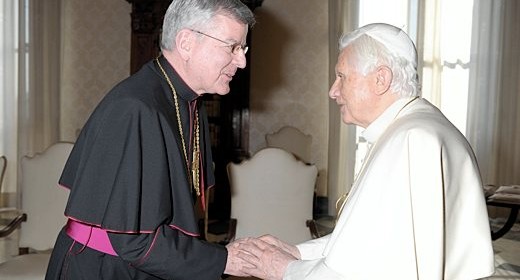
The Holy Father with the ordinary of my home Archdiocese,
Archbishop John Neinstedt
The following is the text of the Holy Father, Pope Benedict XVI, in his Ad Limina Apostolorum Address to bishops of Minnesota, North Dakota, South Dakota.  In it the Holy Father confirms them in the faith, particularly with regard to the one-man one-woman covenanted sacramental union of marriage:

Dear Brother Bishops, 
I greet all of you with fraternal affection on the occasion of your visit “ad limina Apostolorum.” As you know, this year I wish to reflect with you on certain aspects of the evangelization of American culture in the light of the intellectual and ethical challenges of the present moment. 
In our previous meetings I acknowledged our concern about threats to freedom of conscience, religion and worship which need to be addressed urgently, so that all men and women of faith, and the institutions they inspire, can act in accordance with their deepest moral convictions. In this talk I would like to discuss another serious issue which you raised with me during my Pastoral Visit to America, namely, the contemporary crisis of marriage and the family, and, more generally, of the Christian vision of human sexuality. It is in fact increasingly evident that a weakened appreciation of the indissolubility of the marriage covenant, and the widespread rejection of a responsible, mature sexual ethic grounded in the practice of chastity, have led to grave societal problems bearing an immense human and economic cost. 
Yet, as Blessed John Paul II observed, the future of humanity passes by way of the family (cf. “Familiaris Consortio,” 85). Indeed, “the good that the Church and society as a whole expect from marriage and from the family founded on marriage is so great as to call for full pastoral commitment to this particular area. Marriage and the family are institutions that must be promoted and defended from every possible misrepresentation of their true nature, since whatever is injurious to them is injurious to society itself” (“Sacramentum Caritatis,” 29).
In this regard, particular mention must be made of the powerful political and cultural currents seeking to alter the legal definition of marriage. The Church’s conscientious effort to resist this pressure calls for a reasoned defense of marriage as a natural institution consisting of a specific communion of persons, essentially rooted in the complementarity of the sexes and oriented to procreation. Sexual differences cannot be dismissed as irrelevant to the definition of marriage. Defending the institution of marriage as a social reality is ultimately a question of justice, since it entails safeguarding the good of the entire human community and the rights of parents and children alike. 
In our conversations, some of you have pointed with concern to the growing difficulties encountered in communicating the Church’s teaching on marriage and the family in its integrity, and to a decrease in the number of young people who approach the sacrament of matrimony. Certainly we must acknowledge deficiencies in the catechesis of recent decades, which failed at times to communicate the rich heritage of Catholic teaching on marriage as a natural institution elevated by Christ to the dignity of a sacrament, the vocation of Christian spouses in society and in the Church, and the practice of marital chastity. This teaching, stated with increasing clarity by the post-conciliar magisterium and comprehensively presented in both the “Catechism of the Catholic Church” and the “Compendium of the Social Doctrine of the Church,” needs to be restored to its proper place in preaching and catechetical instruction.
On the practical level, marriage preparation programs must be carefully reviewed to ensure that there is greater concentration on their catechetical component and their presentation of the social and ecclesial responsibilities entailed by Christian marriage. In this context we cannot overlook the serious pastoral problem presented by the widespread practice of cohabitation, often by couples who seem unaware that it is gravely sinful, not to mention damaging to the stability of society. I encourage your efforts to develop clear pastoral and liturgical norms for the worthy celebration of matrimony which embody an unambiguous witness to the objective demands of Christian morality, while showing sensitivity and concern for young couples.
Here too I would express my appreciation of the pastoral programs which you are promoting in your Dioceses and, in particular, the clear and authoritative presentation of the Church’s teaching found in your 2009 Letter “Marriage: Love and Life in the Divine Plan.” I also appreciate all that your parishes, schools and charitable agencies do daily to support families and to reach out to those in difficult marital situations, especially the divorced and separated, single parents, teenage mothers and women considering abortion, as well as children suffering the tragic effects of family breakdown. 
In this great pastoral effort there is an urgent need for the entire Christian community to recover an appreciation of the virtue of chastity. The integrating and liberating function of this virtue (cf. “Catechism of the Catholic Church,” 2338-2343) should be emphasized by a formation of the heart, which presents the Christian understanding of sexuality as a source of genuine freedom, happiness and the fulfillment of our fundamental and innate human vocation to love. It is not merely a question of presenting arguments, but of appealing to an integrated, consistent and uplifting vision of human sexuality. The richness of this vision is more sound and appealing than the permissive ideologies exalted in some quarters; these in fact constitute a powerful and destructive form of counter-catechesis for the young. 
Young people need to encounter the Church’s teaching in its integrity, challenging and countercultural as that teaching may be; more importantly, they need to see it embodied by faithful married couples who bear convincing witness to its truth. They also need to be supported as they struggle to make wise choices at a difficult and confusing time in their lives. Chastity, as the Catechism reminds us, involves an ongoing “apprenticeship in self-mastery which is a training in human freedom” (2339). In a society which increasingly tends to misunderstand and even ridicule this essential dimension of Christian teaching, young people need to be reassured that “if we let Christ into our lives, we lose nothing, absolutely nothing, of what makes life free, beautiful and great” (“Homily, Inaugural Mass of the Pontificate,” 24 April 2005). 
Let me conclude by recalling that all our efforts in this area are ultimately concerned with the good of children, who have a fundamental right to grow up with a healthy understanding of sexuality and its proper place in human relationships. Children are the greatest treasure and the future of every society: truly caring for them means recognizing our responsibility to teach, defend and live the moral virtues which are the key to human fulfillment. It is my hope that the Church in the United States, however chastened by the events of the past decade, will persevere in its historic mission of educating the young and thus contribute to the consolidation of that sound family life which is the surest guarantee of intergenerational solidarity and the health of society as a whole. 
I now commend you and your brother Bishops, with the flock entrusted to your pastoral care, to the loving intercession of the Holy Family of Jesus, Mary and Joseph. To all of you I willingly impart my Apostolic Blessing as a pledge of wisdom, strength and peace in the Lord.

Tuesday, March 6, 2012

The UK Government's Attempt to Redefine Reality by Redefining the One-Man One-Woman Covenant of Marriage


Imagine for a moment if someone one day tried to announce that a new law would try to redefine gravity, and that a whole bunch of people were about to jump off a sky scraper in the capitol city to prove that gravity is a law that we could just do without.
This is no different from someone trying to redefine the natural law of marriage, that is, as the President and Vice-President of the Catholic Bishops Conference for England and Wales have said in a letter that will be read in 2,500 parishes this weekend (Full Text), "written in our nature" and "is the pattern of complementarity and fertility."  It is not a law that anyone has the right or authority to change.  The only way it could be changed is that if God would create new laws into the fabric of creation, much like suddenly creating objects to float away from instead toward a center of gravity.
The one-man, one-woman covenanted union is the image and likeness of God, which is why God will certainly not wake up one day and decide to change the law of nature written into our bones.  God is a family, the Eternal Family of the Father and the Son, whose perfect Love eternally sprites the Holy Spirit, just as the love between man and woman is such a perfect union that 9 months later you have to give it a name.
This is also why according to the most senior prelate of Great Britain, 
"In Article 16 of the Universal Declaration on Human Rights, marriage is defined as a relationship between men and women. But when our politicians suggest jettisoning the established understanding of marriage and subverting its meaning they aren’t derided. 
"Instead, their attempt to redefine reality is given a polite hearing, their madness is indulged. Their proposal represents a grotesque subversion of a universally accepted human right."

This kind of foolishness must be stopped.  We have a political and moral responsibility to stop it.  To do so the Catholic Bishops who wrote the letter about marriage suggest signing this declaration, which will tell our government leaders that we do not want a loud minority to control the well being of the UK and this is not tolerable.
I support the legal definition of marriage which is the voluntary union for life of one man and one woman to the exclusion of all others. I oppose any attempt to redefine it.


Friday, March 2, 2012

A Masculine Affirmation of Womanhood, Femininity, Woman, and her Fertility: Talk Given on the Occasion of World Day of Prayer for Women

This talk was given for World Day of Prayer for Women, which took place on March 2nd, 2012.


If you have trouble listening to the audio file, click here.

How can a man dare to talk about womanhood?  Perhaps we should rather ask, how can he dare not?  Most of the wounds caused to women are actually inflicted by men.  This is true also of the terrible wounds caused by neglect.  Although some women do not help the situation by facilitating their objectification with pornography and the sex industry many of the women found in these situations are there because of men in the first place.  So it is not only appropriate but necessary for men to speak about women and we might say that there is a necessary affirmation of femininity that must be made by men in order for justice to be restored.

The first thing we discover about women is that THE MAN, Jesus affirms them, or rather he himself personally experiences their pain.  This is witnessed to in his words:
"Whatsoever you do to the least of my brethren you do to me" (Matthew 25:45)
On the cross, His "loud cries" (Hebrews 5:7) were a summation of the cry of women who find themselves in so many oppressive and evil situations around the world.  Most particularly this is true for those women in the womb who because of abortion never see the light of day, and also for the mothers who are led into the disturbing situation of aborting their own children because they find themselves alone, abandoned, or pressured by their husbands and boyfriends.

Jesus leads us, Pope John Paul II said in his Apostolic Letter On the Dignity and Vocation of Women,
"in the eyes of his contemporaries Christ became a promotor of women's true dignity and of the vocation corresponding to this dignity. At times this caused wonder, surprise, often to the point of scandal: "They marvelled that he was talking with a woman" (Jn 4:27), because this behaviour differed from that of his contemporaries." (12)
He leads us to a kind of "rereading of Genesis" in light of women's dignity.  Looking at the command of God to the man "to till the earth and keep it," (Genesis 2:15) or better to clarify that the Hebrew signifies "to guard it."  Adam you dummy!  You didn't guard it and you didn't guard your woman!  You neglected her.  You committed the first sin.  The serpent shouldn't have ever been able to get near her but you weren't doing your job and so she fell.  This shows us most of man's sins against women.  Most of the wounds that women have are from neglect.  How many unloved daughters, uncherished wives, unprotected sisters, un-cared-for mothers have to cry out to heaven and earth before man will hear them?  They say that 60% of all abuse cases are actually neglect.  How many women who became pregnant found themselves willfully neglected by the same man who is supposed to be a father and protecter of the child he has begotten?


Jesus also shows us the way he interacts with women by his encounter with the Samaritan woman in John 4:4-42.  First of all, he talks to her.  She, a Samaritan, a woman, and even an outcast among the women Samaritans, which is evident because she has avoided the morning crowd and has gone to the well at midday.  Jesus asks her for a drink.  This is the way many women first encounter the Lord.  Non threatening thirsty, Jesus thirsts for a drink of their love, attention, and nurturing care when he presents himself to them in the children, in the poor, in the needy, to which many women respond generously.  Then once he has started the conversation he moves them deeper into communion with himself by offering them the living Water of the Holy Spirit that step by step they see that Jesus is pleased to sit with them, to be with them, to affirm them as they are, but then bring them into God.  He wasn't even swayed or put-off by her many broken relationships as others were, referring to the five men who were not her husbands.  Realizing that Jesus loved her just as she is in all her brokenness, she went and told the whole town, evangelizing them about Jesus Christ the Messiah.


Men need to learn from Jesus how to lay our lives down for women.  They need to learn how to lay down their male ego, which is actually quite difficult for men, so that they approach woman just as she is in all her feminine richness, not neglecting or avoiding her, but treasuring her as a gift.


Mary is the sign par excellence of the affirmation of womanhood.  She is THE SIGN of the Scriptures of the love of God.  This is found in Genesis 3:15 where the woman's offspring will crush the head of the serpent, in Isaiah 7:14 where the sign given to Ahaz is the virgin whose son is Emmanuel, the great sign of Revelations 12:1 of the woman clothed with the sun with the moon at her feet and a crown of twelve stars. It is also the sign given to the Magi and the shepherds for when 
"they saw the child with Mary his mother. They prostrated themselves and did him homage" (Matthew 2:11)
This sign reveals Mary always together with Jesus, just as authentic femininity, to understand it should not be pitted against or compared with masculinity but never separated and seen as a complement.  For woman and man are a gift one to the other and their true value is seen together in communion.  This is the error of some strains of feminism which may seek to masculinize women making them equals to men.  They are equal in human  dignity of personhood but not in feminine dignity, which is very different than masculine dignity and vocation.


May the prayers of the Immaculate Virgin Mary help us to understand woman's true dignity and vocation.

Thursday, March 1, 2012

Theology of the Body Lenten Series Part I of IV: Prayer Fasting and Almsgiving in the Redemption of the Body

Living in a culture of lust where pleasure seeking and hedonism are the norm rather than the exception, there is a clear need for the redemption of the body and its meaning.  The holy season of Lent is a great time to focus on the redemption of the body through the traditional means of prayer, fasting, and almsgiving.  Jesus gave us these three tools to respond to man's treble concupiscence of pride, lust, and greed.


This talk was given at St Patrick's Catholic Church in Soho, London, on February 29, 2012 by Fr Samuel Medley, SOLT.  It starts off - to be frank - a bit slow, but as soon as he ditches the notes it picks up and ends strong.  Below are the notes that he ditched after a few minutes.

Redemption of the Body

Wednesday, February 29, 2012

Theology of the Body Lecture Series St Patrick's in Soho, London, Lent 2012 with Fr Samuel Medley, SOLT

Wednesday's during Lent of this year there will be a four part series on the Theology of the Body given by Fr Samuel Medley, SOLT.

at St Patrick's Catholic Church (basement)
21a Soho Square, London W1D 4NR

February 29th - Prayer, Fasting, and Almsgiving in the Redemption of the Body
March 14th - Healing our Relationships through Graced Friendships
March 21st - Single Blessedness, A Vocation to Be Present to the Lord
March 28th - Redemptive Suffering: Offering Christ Crucified in our own Flesh

Free Admission

For More Info: Robert543@gmail.com or 07947698195
Light Refreshments from 6:30pm, Talk from 7pm

Read the text of the Blessed Pope John Paul II's Theology of the Body