Sunday, March 11, 2012

Jesus Cleanses the Temple: Every Lent the Holy Spirit Purifies the Church and This Year He Illumines Us On Marriage


Listen to my homily for this Sunday:


If you have trouble listening, click here,


The Holy Spirit cleanses the temple of the Church each Lent like a holy river of light, sifting and purifying.  This year the entire nations of England and Wales are being cleansed in the meaning of the one-man one-woman sacramental covenant of holy matrimony.  Man and woman were created in a marital bond to replicate on earth the bond of the Most Holy Trinity.  Just as man and woman's sublime union brings forth human life, the eternal and blessed union of the Father and Son brings forth the divine life of the Holy Spirit.

Dear Brothers and Sisters in Jesus Christ,

This week the Coalition Government is expected to present its consultation paper on the proposed change in the legal definition of marriage so as to open the institution of marriage to same-sex partnerships.
Today we want to put before you the Catholic vision of marriage and the light it casts on the importance of marriage for our society.
The roots of the institution of marriage lie in our nature. Male and female we have been created, and written into our nature is this pattern of complementarity and fertility. This pattern is, of course, affirmed by many other religious traditions. Christian teaching fills out this pattern and reveals its deepest meaning, but neither the Church nor the State has the power to change this fundamental understanding of marriage itself.
Nor is this simply a matter of public opinion. Understood as a lifelong commitment between a man and a woman, and for the creation and upbringing of children, marriage is an expression of our fundamental humanity. Its status in law is the prudent fruit of experience, for the good of the spouses and the good of the family. In this way society esteems the married couple as the source and guardians of the next generation. As an institution marriage is at the foundation of our society.
There are many reasons why people get married. For most couples, there is an instinctive understanding that the stability of a marriage provides the best context for the flourishing of their relationship and for bringing up their children. Society recognises marriage as an important institution for these same reasons: to enhance stability in society and to respect and support parents in the crucial task of having children and bringing them up as well as possible.
The Church starts from this appreciation that marriage is a natural institution, and indeed the Church recognises civil marriage. The Catholic understanding of marriage, however, raises this to a new level. As the Catechism says: “The matrimonial covenant, by which a man and a woman establish between themselves a partnership of the whole of life, by its nature is ordered toward the good of the spouses and the procreation and education of offspring; this covenant between baptised persons has been raised by Christ the Lord to the dignity of a sacrament.” (para.1601)
These rather abstract words are reflected however imperfectly in the experience of married couples. We know that at the heart of a good marriage is a relationship of astonishing power and richness, for the couple, their children, their wider circle of friends and relations and society. As a Sacrament, this is a place where divine grace flows. Indeed, marriage is a sharing in the mystery of God’s own life: the unending and perfect flow of love between Father, Son and Holy Spirit.
We know, too, that just as God’s love is creative, so too the love of husband and wife is creative of new life. It is open, in its essence, to welcoming new life, ready to love and nurture that life to its fullness, not only here on earth but also into eternity.
This is a high and noble vision, for marriage is a high and noble vocation. It is not easily followed. But we are sure that Christ is at the heart of marriage, for his presence is a sure gift of the God who is Love, who wants nothing more than for the love of husband and wife to find its fulfilment. So the daily effort that marriage requires, the many ways in which family living breaks and reshapes us, is a sharing in the mission of Christ, that of making visible in the world the creative and forgiving love of God.
In these ways we understand marriage to be a call to holiness for a husband and wife, with children recognised and loved as the gift of God, with fidelity and permanence as the boundaries which create its sacred space. Marriage is also a crucial witness in our society, contributing to its stability, its capacity for compassion and forgiveness and its future, in a way that no other institution can.
In putting before you these thoughts about why marriage is so important, we also want to recognise the experience of those who have suffered the pain of bereavement or relationship breakdown and their contribution to the Church and society. Many provide a remarkable example of courage and fidelity. Many strive to make the best out of difficult and complex situations. We hope that they are always welcomed and helped to feel valued members of our parish communities.
The reasons given by our government for wanting to change the definition of marriage are those of equality and discrimination. But our present law does not discriminate unjustly when it requires both a man and a woman for marriage. It simply recognises and protects the distinctive nature of marriage.
Changing the legal definition of marriage would be a profoundly radical step. Its consequences should be taken seriously now. The law helps to shape and form social and cultural values. A change in the law would gradually and inevitably transform society’s understanding of the purpose of marriage. It would reduce it just to the commitment of the two people involved. There would be no recognition of the complementarity of male and female or that marriage is intended for the procreation and education of children.
We have a duty to married people today, and to those who come after us, to do all we can to ensure that the true meaning of marriage is not lost for future generations.
Most Reverend V. Nichols
Most Reverend P. Smith

The Holy Father Confirms in Faith the Bishops on the Meaning of the One-Man One-Woman Covenanted Sacramental Union of Marriage

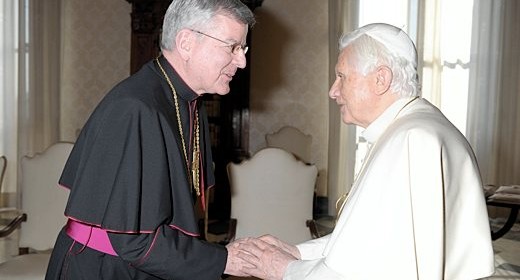
The Holy Father with the ordinary of my home Archdiocese,
Archbishop John Neinstedt
The following is the text of the Holy Father, Pope Benedict XVI, in his Ad Limina Apostolorum Address to bishops of Minnesota, North Dakota, South Dakota.  In it the Holy Father confirms them in the faith, particularly with regard to the one-man one-woman covenanted sacramental union of marriage:

Dear Brother Bishops, 
I greet all of you with fraternal affection on the occasion of your visit “ad limina Apostolorum.” As you know, this year I wish to reflect with you on certain aspects of the evangelization of American culture in the light of the intellectual and ethical challenges of the present moment. 
In our previous meetings I acknowledged our concern about threats to freedom of conscience, religion and worship which need to be addressed urgently, so that all men and women of faith, and the institutions they inspire, can act in accordance with their deepest moral convictions. In this talk I would like to discuss another serious issue which you raised with me during my Pastoral Visit to America, namely, the contemporary crisis of marriage and the family, and, more generally, of the Christian vision of human sexuality. It is in fact increasingly evident that a weakened appreciation of the indissolubility of the marriage covenant, and the widespread rejection of a responsible, mature sexual ethic grounded in the practice of chastity, have led to grave societal problems bearing an immense human and economic cost. 
Yet, as Blessed John Paul II observed, the future of humanity passes by way of the family (cf. “Familiaris Consortio,” 85). Indeed, “the good that the Church and society as a whole expect from marriage and from the family founded on marriage is so great as to call for full pastoral commitment to this particular area. Marriage and the family are institutions that must be promoted and defended from every possible misrepresentation of their true nature, since whatever is injurious to them is injurious to society itself” (“Sacramentum Caritatis,” 29).
In this regard, particular mention must be made of the powerful political and cultural currents seeking to alter the legal definition of marriage. The Church’s conscientious effort to resist this pressure calls for a reasoned defense of marriage as a natural institution consisting of a specific communion of persons, essentially rooted in the complementarity of the sexes and oriented to procreation. Sexual differences cannot be dismissed as irrelevant to the definition of marriage. Defending the institution of marriage as a social reality is ultimately a question of justice, since it entails safeguarding the good of the entire human community and the rights of parents and children alike. 
In our conversations, some of you have pointed with concern to the growing difficulties encountered in communicating the Church’s teaching on marriage and the family in its integrity, and to a decrease in the number of young people who approach the sacrament of matrimony. Certainly we must acknowledge deficiencies in the catechesis of recent decades, which failed at times to communicate the rich heritage of Catholic teaching on marriage as a natural institution elevated by Christ to the dignity of a sacrament, the vocation of Christian spouses in society and in the Church, and the practice of marital chastity. This teaching, stated with increasing clarity by the post-conciliar magisterium and comprehensively presented in both the “Catechism of the Catholic Church” and the “Compendium of the Social Doctrine of the Church,” needs to be restored to its proper place in preaching and catechetical instruction.
On the practical level, marriage preparation programs must be carefully reviewed to ensure that there is greater concentration on their catechetical component and their presentation of the social and ecclesial responsibilities entailed by Christian marriage. In this context we cannot overlook the serious pastoral problem presented by the widespread practice of cohabitation, often by couples who seem unaware that it is gravely sinful, not to mention damaging to the stability of society. I encourage your efforts to develop clear pastoral and liturgical norms for the worthy celebration of matrimony which embody an unambiguous witness to the objective demands of Christian morality, while showing sensitivity and concern for young couples.
Here too I would express my appreciation of the pastoral programs which you are promoting in your Dioceses and, in particular, the clear and authoritative presentation of the Church’s teaching found in your 2009 Letter “Marriage: Love and Life in the Divine Plan.” I also appreciate all that your parishes, schools and charitable agencies do daily to support families and to reach out to those in difficult marital situations, especially the divorced and separated, single parents, teenage mothers and women considering abortion, as well as children suffering the tragic effects of family breakdown. 
In this great pastoral effort there is an urgent need for the entire Christian community to recover an appreciation of the virtue of chastity. The integrating and liberating function of this virtue (cf. “Catechism of the Catholic Church,” 2338-2343) should be emphasized by a formation of the heart, which presents the Christian understanding of sexuality as a source of genuine freedom, happiness and the fulfillment of our fundamental and innate human vocation to love. It is not merely a question of presenting arguments, but of appealing to an integrated, consistent and uplifting vision of human sexuality. The richness of this vision is more sound and appealing than the permissive ideologies exalted in some quarters; these in fact constitute a powerful and destructive form of counter-catechesis for the young. 
Young people need to encounter the Church’s teaching in its integrity, challenging and countercultural as that teaching may be; more importantly, they need to see it embodied by faithful married couples who bear convincing witness to its truth. They also need to be supported as they struggle to make wise choices at a difficult and confusing time in their lives. Chastity, as the Catechism reminds us, involves an ongoing “apprenticeship in self-mastery which is a training in human freedom” (2339). In a society which increasingly tends to misunderstand and even ridicule this essential dimension of Christian teaching, young people need to be reassured that “if we let Christ into our lives, we lose nothing, absolutely nothing, of what makes life free, beautiful and great” (“Homily, Inaugural Mass of the Pontificate,” 24 April 2005). 
Let me conclude by recalling that all our efforts in this area are ultimately concerned with the good of children, who have a fundamental right to grow up with a healthy understanding of sexuality and its proper place in human relationships. Children are the greatest treasure and the future of every society: truly caring for them means recognizing our responsibility to teach, defend and live the moral virtues which are the key to human fulfillment. It is my hope that the Church in the United States, however chastened by the events of the past decade, will persevere in its historic mission of educating the young and thus contribute to the consolidation of that sound family life which is the surest guarantee of intergenerational solidarity and the health of society as a whole. 
I now commend you and your brother Bishops, with the flock entrusted to your pastoral care, to the loving intercession of the Holy Family of Jesus, Mary and Joseph. To all of you I willingly impart my Apostolic Blessing as a pledge of wisdom, strength and peace in the Lord.

Tuesday, March 6, 2012

The UK Government's Attempt to Redefine Reality by Redefining the One-Man One-Woman Covenant of Marriage


Imagine for a moment if someone one day tried to announce that a new law would try to redefine gravity, and that a whole bunch of people were about to jump off a sky scraper in the capitol city to prove that gravity is a law that we could just do without.
This is no different from someone trying to redefine the natural law of marriage, that is, as the President and Vice-President of the Catholic Bishops Conference for England and Wales have said in a letter that will be read in 2,500 parishes this weekend (Full Text), "written in our nature" and "is the pattern of complementarity and fertility."  It is not a law that anyone has the right or authority to change.  The only way it could be changed is that if God would create new laws into the fabric of creation, much like suddenly creating objects to float away from instead toward a center of gravity.
The one-man, one-woman covenanted union is the image and likeness of God, which is why God will certainly not wake up one day and decide to change the law of nature written into our bones.  God is a family, the Eternal Family of the Father and the Son, whose perfect Love eternally sprites the Holy Spirit, just as the love between man and woman is such a perfect union that 9 months later you have to give it a name.
This is also why according to the most senior prelate of Great Britain, 
"In Article 16 of the Universal Declaration on Human Rights, marriage is defined as a relationship between men and women. But when our politicians suggest jettisoning the established understanding of marriage and subverting its meaning they aren’t derided. 
"Instead, their attempt to redefine reality is given a polite hearing, their madness is indulged. Their proposal represents a grotesque subversion of a universally accepted human right."

This kind of foolishness must be stopped.  We have a political and moral responsibility to stop it.  To do so the Catholic Bishops who wrote the letter about marriage suggest signing this declaration, which will tell our government leaders that we do not want a loud minority to control the well being of the UK and this is not tolerable.
I support the legal definition of marriage which is the voluntary union for life of one man and one woman to the exclusion of all others. I oppose any attempt to redefine it.


Friday, March 2, 2012

A Masculine Affirmation of Womanhood, Femininity, Woman, and her Fertility: Talk Given on the Occasion of World Day of Prayer for Women

This talk was given for World Day of Prayer for Women, which took place on March 2nd, 2012.


If you have trouble listening to the audio file, click here.

How can a man dare to talk about womanhood?  Perhaps we should rather ask, how can he dare not?  Most of the wounds caused to women are actually inflicted by men.  This is true also of the terrible wounds caused by neglect.  Although some women do not help the situation by facilitating their objectification with pornography and the sex industry many of the women found in these situations are there because of men in the first place.  So it is not only appropriate but necessary for men to speak about women and we might say that there is a necessary affirmation of femininity that must be made by men in order for justice to be restored.

The first thing we discover about women is that THE MAN, Jesus affirms them, or rather he himself personally experiences their pain.  This is witnessed to in his words:
"Whatsoever you do to the least of my brethren you do to me" (Matthew 25:45)
On the cross, His "loud cries" (Hebrews 5:7) were a summation of the cry of women who find themselves in so many oppressive and evil situations around the world.  Most particularly this is true for those women in the womb who because of abortion never see the light of day, and also for the mothers who are led into the disturbing situation of aborting their own children because they find themselves alone, abandoned, or pressured by their husbands and boyfriends.

Jesus leads us, Pope John Paul II said in his Apostolic Letter On the Dignity and Vocation of Women,
"in the eyes of his contemporaries Christ became a promotor of women's true dignity and of the vocation corresponding to this dignity. At times this caused wonder, surprise, often to the point of scandal: "They marvelled that he was talking with a woman" (Jn 4:27), because this behaviour differed from that of his contemporaries." (12)
He leads us to a kind of "rereading of Genesis" in light of women's dignity.  Looking at the command of God to the man "to till the earth and keep it," (Genesis 2:15) or better to clarify that the Hebrew signifies "to guard it."  Adam you dummy!  You didn't guard it and you didn't guard your woman!  You neglected her.  You committed the first sin.  The serpent shouldn't have ever been able to get near her but you weren't doing your job and so she fell.  This shows us most of man's sins against women.  Most of the wounds that women have are from neglect.  How many unloved daughters, uncherished wives, unprotected sisters, un-cared-for mothers have to cry out to heaven and earth before man will hear them?  They say that 60% of all abuse cases are actually neglect.  How many women who became pregnant found themselves willfully neglected by the same man who is supposed to be a father and protecter of the child he has begotten?


Jesus also shows us the way he interacts with women by his encounter with the Samaritan woman in John 4:4-42.  First of all, he talks to her.  She, a Samaritan, a woman, and even an outcast among the women Samaritans, which is evident because she has avoided the morning crowd and has gone to the well at midday.  Jesus asks her for a drink.  This is the way many women first encounter the Lord.  Non threatening thirsty, Jesus thirsts for a drink of their love, attention, and nurturing care when he presents himself to them in the children, in the poor, in the needy, to which many women respond generously.  Then once he has started the conversation he moves them deeper into communion with himself by offering them the living Water of the Holy Spirit that step by step they see that Jesus is pleased to sit with them, to be with them, to affirm them as they are, but then bring them into God.  He wasn't even swayed or put-off by her many broken relationships as others were, referring to the five men who were not her husbands.  Realizing that Jesus loved her just as she is in all her brokenness, she went and told the whole town, evangelizing them about Jesus Christ the Messiah.


Men need to learn from Jesus how to lay our lives down for women.  They need to learn how to lay down their male ego, which is actually quite difficult for men, so that they approach woman just as she is in all her feminine richness, not neglecting or avoiding her, but treasuring her as a gift.


Mary is the sign par excellence of the affirmation of womanhood.  She is THE SIGN of the Scriptures of the love of God.  This is found in Genesis 3:15 where the woman's offspring will crush the head of the serpent, in Isaiah 7:14 where the sign given to Ahaz is the virgin whose son is Emmanuel, the great sign of Revelations 12:1 of the woman clothed with the sun with the moon at her feet and a crown of twelve stars. It is also the sign given to the Magi and the shepherds for when 
"they saw the child with Mary his mother. They prostrated themselves and did him homage" (Matthew 2:11)
This sign reveals Mary always together with Jesus, just as authentic femininity, to understand it should not be pitted against or compared with masculinity but never separated and seen as a complement.  For woman and man are a gift one to the other and their true value is seen together in communion.  This is the error of some strains of feminism which may seek to masculinize women making them equals to men.  They are equal in human  dignity of personhood but not in feminine dignity, which is very different than masculine dignity and vocation.


May the prayers of the Immaculate Virgin Mary help us to understand woman's true dignity and vocation.

Thursday, March 1, 2012

Theology of the Body Lenten Series Part I of IV: Prayer Fasting and Almsgiving in the Redemption of the Body

Living in a culture of lust where pleasure seeking and hedonism are the norm rather than the exception, there is a clear need for the redemption of the body and its meaning.  The holy season of Lent is a great time to focus on the redemption of the body through the traditional means of prayer, fasting, and almsgiving.  Jesus gave us these three tools to respond to man's treble concupiscence of pride, lust, and greed.


This talk was given at St Patrick's Catholic Church in Soho, London, on February 29, 2012 by Fr Samuel Medley, SOLT.  It starts off - to be frank - a bit slow, but as soon as he ditches the notes it picks up and ends strong.  Below are the notes that he ditched after a few minutes.

Redemption of the Body

Wednesday, February 29, 2012

Theology of the Body Lecture Series St Patrick's in Soho, London, Lent 2012 with Fr Samuel Medley, SOLT

Wednesday's during Lent of this year there will be a four part series on the Theology of the Body given by Fr Samuel Medley, SOLT.

at St Patrick's Catholic Church (basement)
21a Soho Square, London W1D 4NR

February 29th - Prayer, Fasting, and Almsgiving in the Redemption of the Body
March 14th - Healing our Relationships through Graced Friendships
March 21st - Single Blessedness, A Vocation to Be Present to the Lord
March 28th - Redemptive Suffering: Offering Christ Crucified in our own Flesh

Free Admission

For More Info: Robert543@gmail.com or 07947698195
Light Refreshments from 6:30pm, Talk from 7pm

Read the text of the Blessed Pope John Paul II's Theology of the Body

Monday, February 27, 2012

Lecture Series Given at Hester's Cafe in Spring 2010, Corpus Christi, Texas

This is a series of lectures given by different speakers that are a commentary on the book of Blessed Pope John Paul II called, Love and Responsibility, that took place in the Spring of 2009 at Hester's Cafe in Corpus Christi, Texas.

Theology of the Body Taught on the Street Level


A simple explanation of  Blessed Pope John Paul II's Theology of the Body on the street level.  It was given in six talks by Fr Samuel Medley, SOLT, at Our Lady of Corpus Christi in Spring of 2009.  For each session there is a video, audio, and a downloadable powerpoint presentation.

Session 1: Man and Woman He Created Them
Session 2: Purity of Heart and Life in the Spirit
Session 3: Resurrection of the Body and Celibacy
Session 4: Dimension of Covenant and of Grace
Session 5: Dimension of the Sign
Session 6: Humanae Vitae and Contraception

Read the Theology of the Body online.

View the first session's video:

Monday, December 19, 2011

And the Word Became a Zygote, and Dwelt Amongst us: Catechesis on Dignitatis Personae and the Dignity of Embryonic Persons


The following is a homily that was given on the 4th Sunday of Advent, which contains a brief catechetical summary and exhortation about the Congregation of the Doctrine of Faith's Instruction on Certain Bioethical Questions, Dignitatis Personae.  This document is very short and is an easy read.  It contains lots of useful tips on how to explain the Church's position using arguments of common sense, or the natural law, besides showing supporting scriptures that teach the truth of morals concerning embryonic persons' inherent dignity.


If you have trouble listening click here.

And the Word became a zygote and dwelt among us
Jesus Christ the Lord became a tiny embryo and thus united himself to all embryos to show that their dignity is just as sacred at the first hour of conception as the rest of the nine months they spend in the womb.  The clarification of the Congregation for the Doctrine of Faith issued in 2008 entitled, Dignitatis Personae, outlines bioethics in relation to embryos and scientific research.
“Thus the fruit of human generation, from the first moment of its existence, that is to say, from the moment the zygote has formed, demands the unconditional respect that is morally due to the human being in his bodily and spiritual totality. The human being is to be respected and treated as a person from the moment of conception; and therefore from that same moment his rights as a person must be recognized, among which in the first place is the inviolable right of every innocent human being to life”
Each embryo, especially because Jesus Christ himself was an embryo at one point in his human growth, has the same dignity accorded any human person.
By virtue of the simple fact of existing, every human being must be fully respected. The introduction of discrimination with regard to human dignity based on biological, psychological, or educational development, or based on health-related criteria, must be excluded. At every stage of his existence, man, created in the image and likeness of God, reflects “the face of his Only-begotten Son…
Therefore any infringement of this dignity of persons in embryonic level of their growth is a grave moral evil that must be stopped.

In vitro fertilization is an infringement of this dignity not only because
1.  "The process of in vitro fertilization very frequently involves the deliberate destruction of embryos" but also because it has the tendency to
2.  "dissociate procreation from the integrally personal context of the conjugal act: human procreation is a personal act of a husband and wife, which is not capable of substitution."
For this reason it must be said that intracytoplasmic injection is also gravely immoral.  However,
Techniques which assist procreation “are not to be rejected on the grounds that they are artificial. As such, they bear witness to the possibilities of the art of medicine. But they must be given a moral evaluation in reference to the dignity of the human person, who is called to realize his vocation from God to the gift of love and the gift of life”
There are many kinds of great medicine that are artificial and totally moral and excellent aids to man living out his vocation.

Other offenses against the dignity of embryonic life of man includes:
-cryogenic preservation of embryos (freezing)
-human cloning
-embryonic stem cell research
-hybridization of man with other animal species
-intraceptive and contragestative processes that compromise the life of the embryo or cause abortion (processes that interfere with implantation of the embryo on the uterine wall or other kind of interference)
It must also be held that genetic therapy or manipulation on embryos to produce a desired personal trait is also gravely immoral.  That is not to say that the use of adult stem cells or gene therapy upon adults compromises any ethical laws, but can greatly advance medical science as a means of healing man's ills in a completely ethical way.

May Our Lady help us to answer the call to defend the dignity of each and every single human person from the moment of conception to natural death.

Friday, December 2, 2011

Contemplating Jesus in the Womb of Mary Can Heal the World

Listen to my homily:


If you have trouble listening click here.

We often see Jesus in a certain way, crucified, risen, glorious, but do we contemplate him ever as he was in the womb of Mary?  Try it.  You'll like it.  It will change you.  It might heal you.  You and every other human person went through this silent darkness as you awaited the advent of your own life on earth.  Go back, go back to the womb of Mary and contemplate the little redeemer who prays and loves you from the silent holy darkness of the Immaculate Womb of Mary.