A simple explanation of Blessed Pope John Paul II's Theology of the Body on the street level. It was given in six talks by Fr Samuel Medley, SOLT, at Our Lady of Corpus Christi in Spring of 2009. For each session there is a video, audio, and a downloadable powerpoint presentation.
The following is a homily that was given on the 4th Sunday of Advent, which contains a brief catechetical summary and exhortation about the Congregation of the Doctrine of Faith's Instruction on Certain Bioethical Questions, Dignitatis Personae. This document is very short and is an easy read. It contains lots of useful tips on how to explain the Church's position using arguments of common sense, or the natural law, besides showing supporting scriptures that teach the truth of morals concerning embryonic persons' inherent dignity.
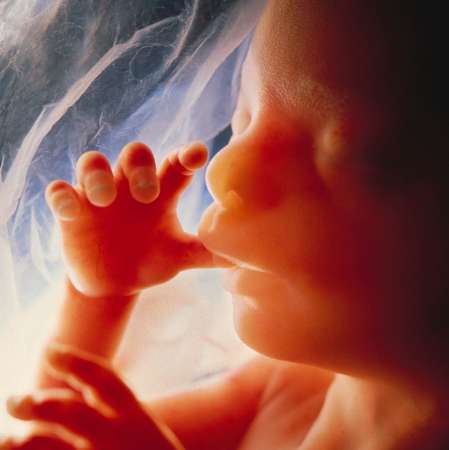
Jesus Christ the Lord became a tiny embryo and thus united himself to all embryos to show that their dignity is just as sacred at the first hour of conception as the rest of the nine months they spend in the womb. The clarification of the Congregation for the Doctrine of Faith issued in 2008 entitled, Dignitatis Personae, outlines bioethics in relation to embryos and scientific research.
“Thus the fruit of human generation, from the first moment of its existence, that is to say, from the moment the zygote has formed, demands the unconditional respect that is morally due to the human being in his bodily and spiritual totality. The human being is to be respected and treated as a person from the moment of conception; and therefore from that same moment his rights as a person must be recognized, among which in the first place is the inviolable right of every innocent human being to life”
Each embryo, especially because Jesus Christ himself was an embryo at one point in his human growth, has the same dignity accorded any human person.
By virtue of the simple fact of existing, every human being must be fully respected. The introduction of discrimination with regard to human dignity based on biological, psychological, or educational development, or based on health-related criteria, must be excluded. At every stage of his existence, man, created in the image and likeness of God, reflects “the face of his Only-begotten Son…
Therefore any infringement of this dignity of persons in embryonic level of their growth is a grave moral evil that must be stopped.
In vitro fertilization is an infringement of this dignity not only because
1. "The process of in vitro fertilization very frequently involves the deliberate destruction of embryos" but also because it has the tendency to
2. "dissociate procreation from the integrally personal context of the conjugal act: human procreation is a personal act of a husband and wife, which is not capable of substitution."
For this reason it must be said that intracytoplasmic injection is also gravely immoral. However,
Techniques which assist procreation “are not to be rejected on the grounds that they are artificial. As such, they bear witness to the possibilities of the art of medicine. But they must be given a moral evaluation in reference to the dignity of the human person, who is called to realize his vocation from God to the gift of love and the gift of life”
There are many kinds of great medicine that are artificial and totally moral and excellent aids to man living out his vocation.
Other offenses against the dignity of embryonic life of man includes:
-cryogenic preservation of embryos (freezing)
-human cloning
-embryonic stem cell research
-hybridization of man with other animal species
-intraceptive and contragestative processes that compromise the life of the embryo or cause abortion (processes that interfere with implantation of the embryo on the uterine wall or other kind of interference)
It must also be held that genetic therapy or manipulation on embryos to produce a desired personal trait is also gravely immoral. That is not to say that the use of adult stem cells or gene therapy upon adults compromises any ethical laws, but can greatly advance medical science as a means of healing man's ills in a completely ethical way.
May Our Lady help us to answer the call to defend the dignity of each and every single human person from the moment of conception to natural death.
We often see Jesus in a certain way, crucified, risen, glorious, but do we contemplate him ever as he was in the womb of Mary? Try it. You'll like it. It will change you. It might heal you. You and every other human person went through this silent darkness as you awaited the advent of your own life on earth. Go back, go back to the womb of Mary and contemplate the little redeemer who prays and loves you from the silent holy darkness of the Immaculate Womb of Mary.
Recently a woman found herself apologizing for crying on my shoulder and taking up my time. I reminded her that God consecrated me for that very purpose, that she would know especially in pain and sorrow, that God deeply loves and cares for her.
In the readings for today, the 31st Sunday in Ordinary Time, we see that a priest is a sign of the tender Love of God the Father, who arranges to give us very real and incarnate signs, or sacraments that we may know his love. A priest is an alter Christus, another Christ, who has been given the sacrament of holy orders so that the people of God may filiate themselves to the Father in very real ways.
How many people find very real consolation, strength, blessing, life, and holiness in their relationship with the priests God has given them! For it is clear that it is the will of God that the relationships of the Most Holy Trinity would be marvelously perpetuated in the Church. When the faithful live as sons in the Son and filiate themselves to the fatherhood of God present in the priesthood of Christ, God is glorified and man is fortified. Yet, on the other hand, there are some priests that do not give consolation but afflict the children of the Church. In recent times we have been very aware of this, almost too aware. The failure of priests has become often the most favorite topic at the bus station, in the grocery store, at homes and workplaces, so much to the point that it would seem that priests may be terrible villains.
It must be remembered that priests, while the dust has been kicked up a lot lately about the sex abuse crisis, are the lowest number of perpetrators and the management of the Church has handled it as the harshest of juridical penalties that civic law would never allow. In Germany, the anti-catholic criminologiest Christian Pfeiffer claims that priests are the least number of offenders as .1% of all cases. In the United States this number is even lower at .03%, while the insurance claims for married clergy are more than double this number and teachers triple. Yet why are priests targeted? Because they should be 0%. They represent God's fatherhood and for this reason the damage is exponentially greater.
Thanks be to Jesus, who gave us this beautiful scripture, to "Call no man on earth our father" (Mt 23:9). He said this so that when we do encounter the sinfulness of the Church, we will not ultimately allow this to shake our faith, because ultimately there is only One Father who is worthy of the name, before whom all other fathers whether spiritual or human appear as a very insufficient substitute or stand-in for the real thing. Now, many so called "bible christians" interpret this scripture out of context. The Catholic principle of interpreting scripture is context. Let the bible interpret itself in light of itself and in light of the Catholic tradition, the magisterial teachings, and the teachings of the fathers and saints.
What is the context? In Exodus 20:12 we hear to "honor our father." In Matthew 3:9 and Luke 3:8 we see that Jesus himself called human men fathers such as Abraham and David. The Blessed Virgin Mary called Abraham as father (Luke 1:55). The Apostles Paul, who surely knew how to interpret scripture called himself father of the disciples in Corinth (1 Cor 4:5) and Thessalonica (1 Thess 2:11-12), and even called St Timothy, a young bishop, his son. Clearly the New Testament tells us that it is right and good to call men by the title father. So what IS the context? Jesus immediately before this passage warns us of those teachers who do not practice what they preach, who
"They tie up heavy burdens hard to carry and lay them on people's shoulders,but they will not lift a finger to move them"
It is clear that this passage ought be interpreted in light of that seemingly harsh first reading for today:
You have turned aside from the way,and have caused many to falter by your instruction;you have made void the covenant of Levi,says the LORD of hosts.
It refers to those priests who do not teach the teachings of Christ present through the legitimate authority of the Church, and therefore rather than help souls enter into life, they impede them. For those Catholic priests who oppose the teaching authority of Christ present in Scripture, Tradition, and the Magisterium, it is time to tremble. The penalty God speaks of here is very severe. But the faithful, ought not get too caught up in their failure, they ought not lose their faith because a so called, "father" or "teacher" has not taught them the correct doctrine, for they share their fatherhood only in a participatory or instrumental way.
In closing, I would like to share with you the words of Archbishop Chaput, which he gave in his homily for the national convention of the Knights of Columbus in Denver, Colorado on August 2, 2011. Watch video here.
"Bishops, priests, and deacons are too often weak and sinful. We need to be held to high standards. Some of us deserve to be chastised. The Church's leadership, the clergy, should always be marked by humility and service, and never by a sense of entitlement. But it is important to remember that men and women did not found the Church. They don't own her and they have no license to reinvent her. The Church belongs to Jesus Christ. The different roles within the Christian community, clergy, laity, and religious life - have equal dignity but different purposes. Certain failures, including the sins of the clergy, need to be named, but when people deride their bishops and priests out of pride or resentment or some perverse desire for what they perceive as power, they undermine the Church itself, and they set themselves against the God whose vessel the Church is, and that, as Scripture suggests, leads in a painful direction. All real reform in the Church today requires two things….renewal begins not in vilifying others but examining ourselves, honestly, repenting of our own sins, and changing ourselves. This applies to every baptized person, from the Pope to the average man or woman earning a wage. We are all sinners. We are all in need of repentance and in need of God's mercy. When we really understand that we can speak to each other with honesty and love and the reform of the Church can begin. The second thing we need for reform in the Church is faith, not faith as in theology, or faith as a collection of doctrines and practices, although these are important, but faith as a single-minded confidence in God. Faith as the humility, and in a sense, the passion and recklessness to give ourselves entirely to God. That kind of faith changes people, that kind of faith shifts the world on its axis, because nothing can stand against it,"
In the Gospel for today, the 29th Sunday in Ordinary Time, Jesus teaches us about the two realms of faith and government as his disciples have dual citizenship both of this world and of the Kingdom of Heaven.
A coin bears the head of the person in charge of the state on it and his name. A human person has inscribed within the very image and name of the Creator, bearing a divine dignity and rights with which he is endowed. To say then that faith can have no bearing on the state is a lie. Anyone who doesn't allow their faith to bear influence on their own political views, the social and economic sphere, not only has dead faith, but actually the words of Jesus apply to him, "You hypocrite!"
THE issue in our time for faith and government is abortion. The reason for this is because the fundamental right to life, and to treated as a human person from the moment of conception is being violated by governments. For those who say that we cannot be stuck on one issue, I would simply point out that Hitler was an ingenius leader who did everything legal but had one little issue of exterminating a portion of the population. Why get stuck on one little issue of genocide?
Like hitlerian germany and the environment of slavery, we are now in an environment where millions are deceived into thinking that a fertilized embryo ought not have acccorded full rights of a human person. When then does their personhood begin? The fertilized embryo is not that of a duck, nor is it simply a tissue, or a machine. It is a person who is simply very small growing every day into a larger person.
In our time, the young, in particular, seem to not have the same fear or reverence for the lie that a child in the womb is not a person, and it is the young that are doing the most in the pro-life movement. A 22 year old woman, Lila Rose, started uncovering the illegal and unethical activity of Planned Parenthood, the world's largest abortion provider, and now it is being defunded slowly of taxpayer's money. A young 23 year old founded 40 days for life, the world's most successful pro-life campaign to stop abortion.
When we look back at hitlerian Germany or times where slavery was decriminalized, we ask those people living in the time, why didn't they see it? Why couldn't they see the evil right in front of them? Why didn't they do anything to stop it? Will generations from now ask that about us with regard to abortion? It isn't going to last forever. Eventually the image and likeness of the human person will be restored.
There are many wonderful programmes for young people to teach them about living the Gospel in their human relationships. However, what the are yearning for is not powerpoint presentations, world-class musicians, speakers, venues, but the unfailing love of Jesus Christ.
This can only be given in the Most Holy Sacrament of the Eucharist. Here Jesus himself touches them, heals them, and reveals to them the glorious face of their Eternal Father, who is Love.
In the Sacrament of Confession, wounds are healed and bound up while the precious and life-giving wounds of Jesus are given to restore to our true dignity.
Here is the second talk I gave at the Wales Pure in Heart conference:
Blessed Pope John Paul said that Jesus Christ has a living dialogue with a person about their body. He called this "A Theology of the Body." In this dialogue God the Father reveals that he has made man in his image and likeness, creating him in Christ before the world began. Jesus shows that he accepts man exactly in his historical situation right now and loves him. The Holy Spirit, who is Love itself, shows that he is ready to bring us from where we are now to where we need to go.
There is great need today for the whole Church, indeed for all mankind, to be taken up into contemplation of the beautiful and graced womanhood of the Blessed Virgin Mary.
Here is my homily for the Solemnity of the Assumption of the Blessed Virgin Mary.
Do not be crushed by sin. Let it be the very thing that inspires repentance and humbles you before God. Continually ask him for mercy through the intercession of Our Lady.